
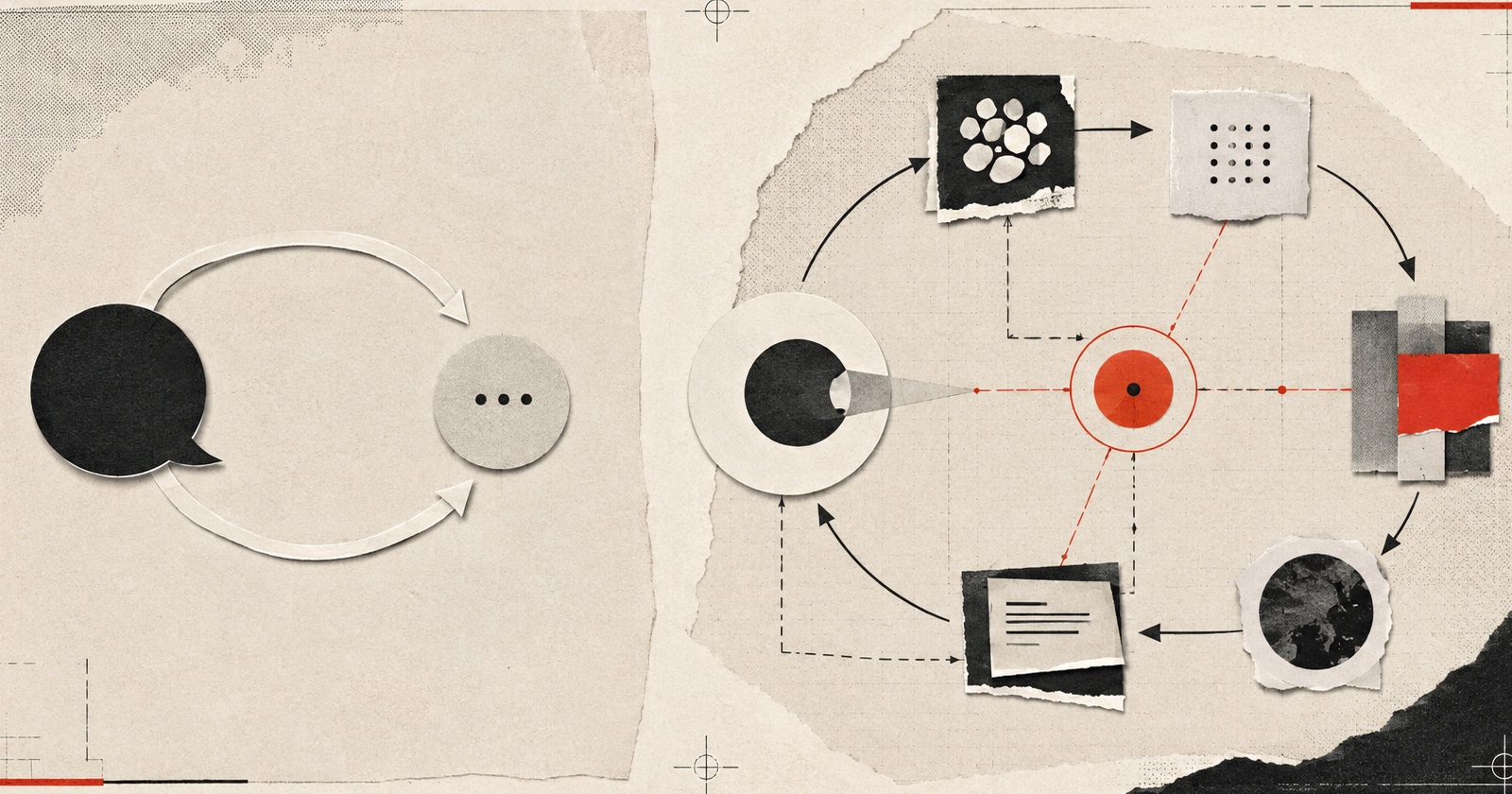
A chatbot responds. An agent acts.
The difference is not that an agent writes better. A chatbot holds a conversation; an agent controls a workflow, uses tools, observes the result and decides what to do next.
Every few months, a technical term becomes a commercial label. Now almost everything appears to be an agent: a search tool with a text box, a chatbot connected to documents or a fixed sequence of automations.
The confusion matters because we buy expectations, not words. If we expect a chat to execute a complete process, we will be disappointed. If we give a system the ability to act while thinking it only generates text, we will take on risks we have not even named.
An answer is not an outcome
A chatbot receives a message and produces an answer. It may be excellent at explaining, drafting, summarising or consulting a knowledge base. It can even call a specific tool. But the conversation remains the main product and the person drives the process.
An agent receives an objective. To achieve it, the agent needs to observe state, choose an action, use tools, check what happened and continue or correct itself. It can stop when the work is complete or return control when it encounters a situation beyond its limits.
The difference can be summarised like this:
| Question | Chatbot | Agent |
|---|---|---|
| What does it receive? | A message | An objective and a state |
| What does it produce? | An answer | A verifiable change or outcome |
| Who drives? | The person | The system, within defined limits |
| Does it use tools? | Optionally | They are an essential part of the work |
| Does it maintain a loop? | Conversational | It observes, acts, checks and corrects |
| What does it need besides the model? | Good context | Tools, permissions, memory, guardrails and evaluation |
Sometimes the right solution is neither
If a process has stable rules, structured data and few exceptional cases, deterministic automation is usually cheaper, more predictable and easier to test. Adding an agent does not automatically improve the system; it can turn a clear rule into a probabilistic decision.
Agents become interesting when work combines unstructured information, context-dependent decisions and a sequence that is difficult to express with hundreds of rules. Even then, autonomy must grow alongside observability and the ability to intervene.
The right commercial question
I would not ask a supplier, “Does your product have agents?” I would ask:
- What objective can it complete from start to finish?
- Which systems can it access, and with what permissions?
- How do we know what it has done?
- Which decisions require approval?
- How does it stop and hand back control?
- How do we evaluate whether the result is good enough?
If the answers still describe a conversation, we are probably looking at a chatbot with a more ambitious name.