AI for an SME: start with a repeated decision, not a tool
An SME does not need to begin with an abstract AI strategy or a fashionable tool. The first useful case is usually hidden inside a decision that repeats, consumes attention and leaves an outcome we can verify.
When a small business asks, “How can we use AI?”, answering with a list of tools is easy and not very useful. The list changes every week and leaves the business with the hardest work: discovering what deserves to change.
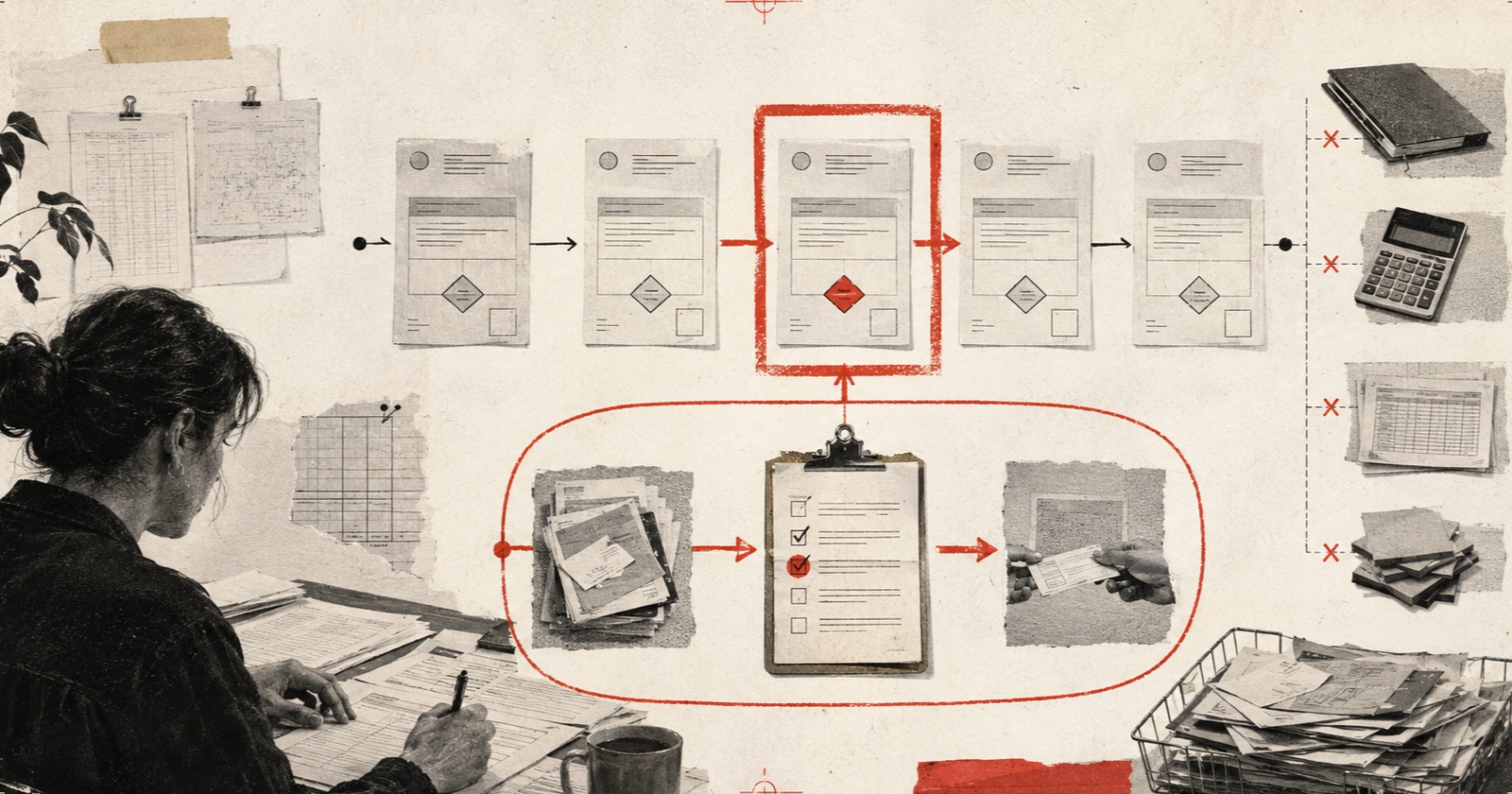
I prefer to begin with a repeated decision. Something that happens several times a month or week, uses recognisable information and ends in an action that someone can evaluate.
It may involve prioritising requests, preparing an offer, classifying an incident, comparing documents, detecting an anomaly or deciding which information is missing before a case can continue.
Why a decision rather than a task
Many visible tasks are only the surface. “Answering emails” may contain several decisions: what is urgent, what information is needed, which response is authorised and who should intervene.
If we automate the surface without understanding those decisions, we produce text faster but do not necessarily improve the process. Naming the decision lets us supply criteria, examples and boundaries.
The canvas for a first use case
Eight questions are enough to explore a case:
- Which decision repeats?
- How often, and who makes it?
- What information does it use?
- Which criteria does an expert apply?
- What outcome does it produce?
- How do we know whether it is good enough?
- What happens if it is wrong?
- At what point should a person intervene?
This canvas helps distinguish whether we need conversational assistance, conventional automation or an agent. It also reveals whether the real problem is AI or the absence of a shared process.
Choose a case that enables learning
The first experiment should happen frequently enough to produce evidence, but be bounded enough for an error to be reversible. It needs an owner and a baseline: how the work is done today, how long it takes, which failures occur and what the recipient of the outcome values.
I would avoid starting with an exceptional decision, an irreversible action or a process full of data that nobody knows how to interpret. I would also avoid a case chosen solely because it produces a spectacular demonstration.
Thirty days to change one decision
A small test can be organised in four movements:
- Week one: observe real cases and capture criteria.
- Week two: build limited assistance using controlled data.
- Week three: use it in parallel without delegating the final decision.
- Week four: compare outcomes, errors, time and confidence.
At the end, we need only decide whether to abandon, adjust, integrate or increase autonomy. Even a negative outcome can be valuable if it avoids a larger investment.
The tool comes afterwards
Once we understand the workflow, we can choose technology according to integration, privacy, cost and capability. If we begin with the purchased product, we will tend to distort the problem to justify it.
An SME does not need to imitate a large corporation applying AI. It needs to turn a concrete friction into a capability its team can maintain.
Sources and references
- OpenAI’s practical guide to identifying and building agents.
- NIST AI Risk Management Framework.
- Primary source: Victor’s experience training and supporting professionals across different departments.